Are you fed up with over 800 pages SOA-books full of conceptual blah blah? Letting you know it is completely nuts not to implement SOA? Telling you SOA is about business and not about technology, or just the other way around? Outlining huge expensive roadmaps involving every bit of the company? Stressing to you not to start if you didn't restructure your business- and IT-organization in advance?
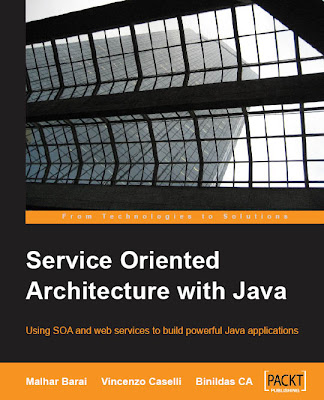
Don't worry, there is some hope for you. I discovered a mind-sized book of less than 200 pages practical no-nonsense knowledge on SOA; 169 pages to be exact.
The authors clearly have a thorough understanding of SOA from a business point-of-view as well as of the application level implementation aspects. They succeeded in bringing SOA to earth, presenting no more and no less of SOA than it is. In their own words:
We convert the business processes to "services" and expose it to be "oriented" with its business goals. The software design "architecture" that conforms to this is SOA.
Not only does this book offer practical insights in the architectural and business aspects of SOA, why XML and web services is a good idea at the implementation level, the limitations of RESTful services, why using an ESB, aspects of data handling in SOA, and tight coupling (which has advantages and disadvantages) versus loose coupling (which has other advantages and disadvantages). The authors also demonstrate how all of this can be implemented with today's available tools and frameworks in a Java environment. You really can try out at home how these concepts work. For this purpose the Java code snippets used in the book are downloadable from the publishers website.
There is an easy case study included which compares a traditional EAI solution with an SOA-based solution of a simplified business problem. Really a brilliant and yet easy to understand illustration.
If you are a programmer (not necessarily a Java programmer) and you want your SOA-programming understanding to be state-of-the-art, this book is one that should be on your shortlist for reading shortly.
But also if you are a designer or an architect with little or no Java knowledge, the book is still very valuable in understanding when and how to apply an SOA-approach; you just skip the Java details.
As I said, it is not an overloaded book as many others are, but just a mind-sized set of interesting need-to-know knowledge from a holistic point-of-view, business as well as implementation, written in a style which offered me a few hours of delightful reading.


 Posts
Posts


28 comments:
Hi..I'm an architect, I like the information about architecture design. Your blog in very nice and you have a great posts.. Visit me back at isdaryanto.com.. Thanks.
Thanks for very interesting article.
Web design company
Nice stuff here. Thanks a lot.
fotografia ślubna Bielsko
great share thanks for this
Thesis | Dissertation | Essay | Assignment
Do you have this site to share a good site.thanks. A variety of electronic books, available here
Blog Posting Service Social media news
Great blog, I really enjoyed this post. I will be back and have bookmarked your site.
Unterwaesche Online Shop
this is a great article! fotograf zdjecia slubne and fotografia slubna bielsko Katowice krakow fine art. Psycholog on Line korzysci pomocy online fotografia dziecieca zdjecia dzieci, fotografia ślubna fotografia ślubna Śląsk małopolska fotograf ślubny fotografia dzieci zdjęcia ślubne depresja stres psycholog i pomoc psychologiczna pomoc psychologa and internetowy psycholog psychologia internetowa poradnia psychologiczna and Psychologia and psycholog online psycholog on-line pomoc psychologiczna przez Internet and psycholog online psycholog internetowy and psycholog przez internet rękodzieło artystyczne galeria etniczna and sztuka etniczna
psycholog
psycholog online
psycholog przez internet
psycholog internetowy
psychologia
psychologia kliniczna
internetowy psycholog
psycholog on line
e-psycholog
psycholog on-line
psychologia
psychologia
psychologia
psycholog
psycholog online
psycholog
psycholog
psycholog internetowy
psychologia
psycholog przez internet
porady psychologa
porady psychologiczne
psycholog
psycholog kliniczny
depresja
stres
psycholog
psycholog online
psychologia
psycholog
You have this site to share a good site.thanks. A variety of electronic books, available here SEO Services Women Beauty Products Holiday Spy watch Camera Sport Products
awesome results…really liked it
Sun Java is one of the most flexible platform for application development Sun Java development gives the way to develop complex applicaton development.
custom papers
This is really good and interesting piece of work. i liked it,and wanted to know more about it.
I have been visiting various blogs for my term papers writing research. I have found your blog to be quite useful. Keep updating your blog with valuable information... Regards
Oh! This is wonderful! My husband and I can use this for our job! We're both architects. :)
looks like a great book. my brother is an arcitect.. im sure he will love it.
-andy from blu-ray ripper and blu ray ripper software
This service with Java architecture is new idea.
thanks for the information regards the Java infrastructure...it's very interesting.build mailing list
I have been visiting various blogs for my term papers writing research. I have found your blog to be quite useful. Keep updating your blog with valuable information
Great blog, I really enjoyed this post. I will be back and have bookmarked your site. Thanks for your great share! Really apriciated
Very informative and trustworthy blog. Please keep updating with great posts like this one. I
have booked marked your site and am about to email it to a few friends of mine that I know
would enjoy reading.
cabal alz
eve isk
I practically gave up on SOA after seeing the super thick books. The one you recommended sure looks interesting and maybe will try SOA again. :)
Dyna, Detoxify the body
Very informative and trustworthy blog. Please keep updating with great posts like this one. I
have booked marked your site and am about to email it to a few friends of mine that I know
would enjoy reading.
wow gold
cheap wow gold
wow gold
buy wow gold
wow gold
cheap wow gold
buy wow gold
Very informative and trustworthy blog. Please keep updating with great posts like this one. I
have booked marked your site and am about to email it to a few friends of mine that I know
would enjoy reading.
lineage 2 adena
cheap lineage 2 adena
lineage 2 adena
buy lineage 2 adena
lineage 2 adena
cheap lineage 2 adena
buy lineage 2 adena
lineage 2 adena
lineage 2 adena
Thanks great info indeed, I'm newbie in Java. This should help, thanks.
Pat @ iphone 4 case, best ipad apps & autoresponder
That’s a great post thanks for your time very interesting, good work
Web Designing Karachi
Totally agree that this is a good read and for those looking for more of the same I can recommend Java Soa Cookbook by Eben Hewitt.
Post a Comment